
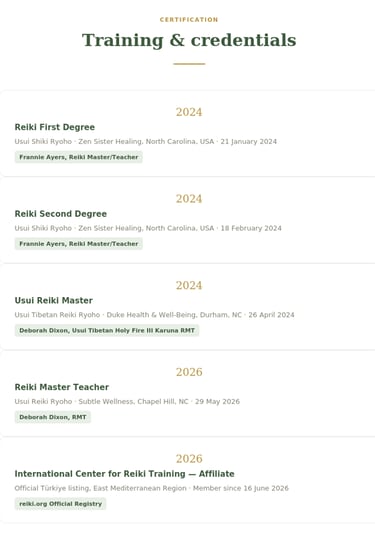
Certified by Duke University and recognised by the International Center for Reiki Training (Reiki.org) as Türkiye's sole member master-teacher.
Reiki Master-Teacher (Highest Level)
But the more I practised, the more I noticed its effect, not just on myself, but on the people closest to me. Friends, family, colleagues who were curious or going through their own difficult seasons began asking me to share it with them. Each time, I saw the same thing: people leaving a session calmer, lighter, more present. That was enough to pull me deeper in.
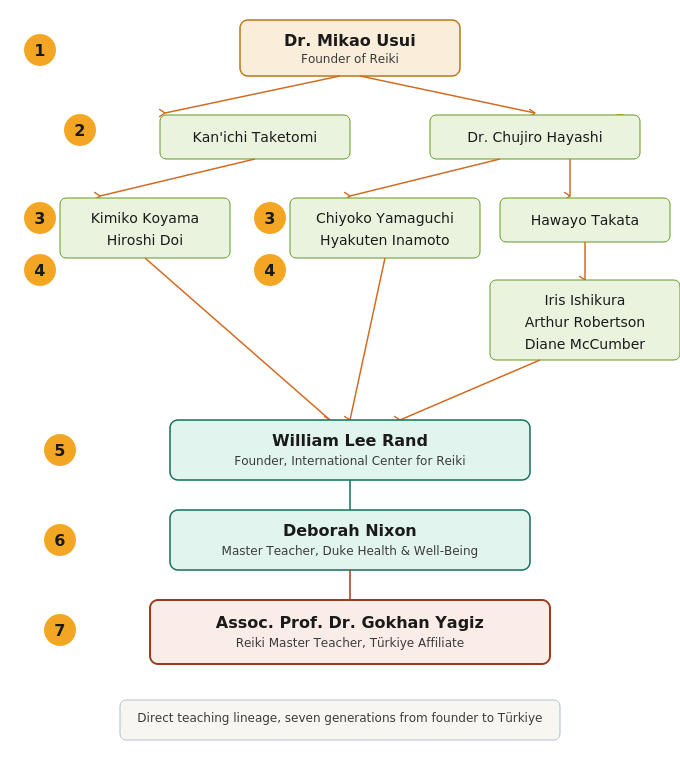
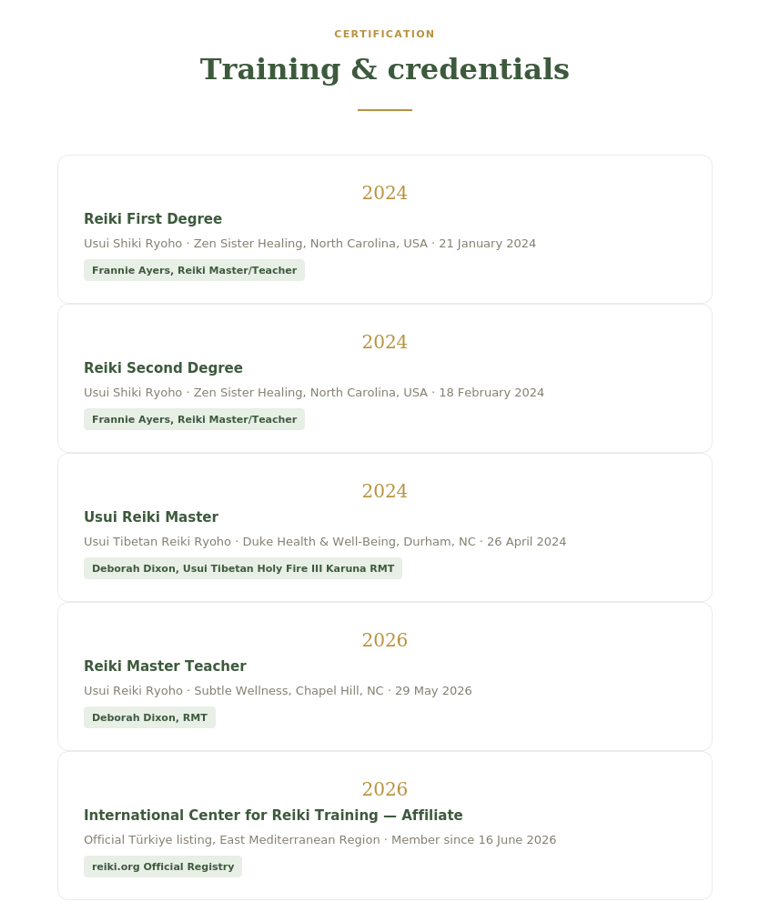
What began as something private slowly became something I wanted to offer more widely. I pursued my training formally: Reiki First Degree, Second Degree, Master, and ultimately Reiki Master Teacher, culminating in training at Duke Health & Well-Being under Deborah Dixon, whose own lineage traces directly back to William Lee Rand and, through him, to Reiki's founder, Dr Mikao Usui.
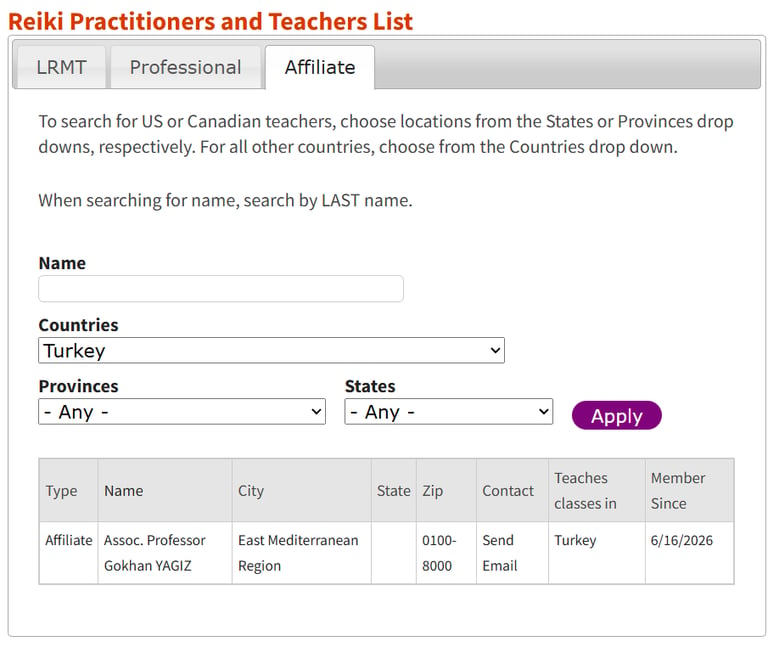
Today, I'm honoured to be recognised as the official Reiki Affiliate for Türkiye on the International Center for Reiki Training registry, a role I hold alongside my academic work, not in place of it. For me, Reiki isn't about replacing science; it's about honouring the parts of healing that science doesn't always have language for, presence, touch, stillness, and the simple act of caring for another person with your full attention.
My Reiki Journey
That search led me to Reiki.
Like many people in academic medicine, I spent years immersed in evidence, imaging, and the precision of clinical science. But a few years ago, while dealing with some health complaints of my own, I found myself looking beyond the conventional toolkit I knew so well. I wasn't searching for a replacement for medicine. I was searching for balance, for a way to support my body and mind that felt different from anything in my professional training.
I approached it the way I approach most things: with curiosity, a healthy dose of scepticism, and an open mind. What I didn't expect was how genuinely restorative the practice would become for me, not as a cure, but as a quiet, grounding companion to everything else I was doing for my well-being. I started learning Reiki simply as a personal practice, almost a hobby, something to bring calm into a busy academic life that spanned continents and time zones.
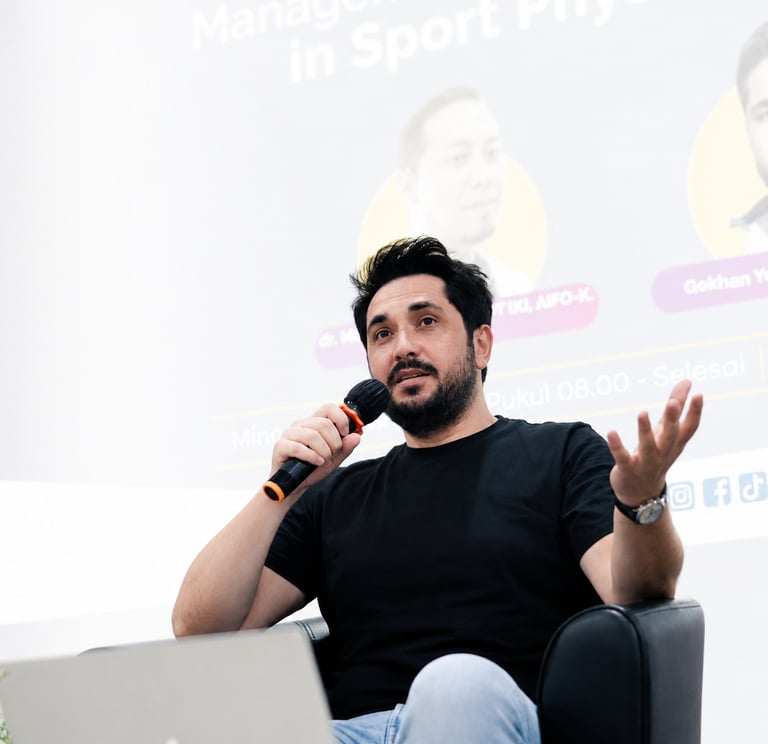
Assoc. Prof. Dr. Gokhan YAGIZ
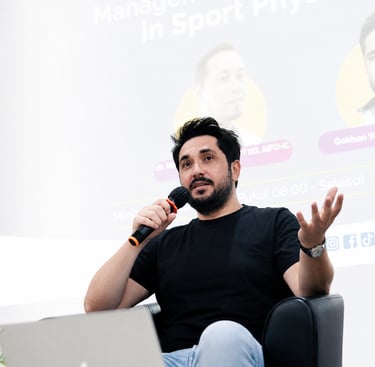
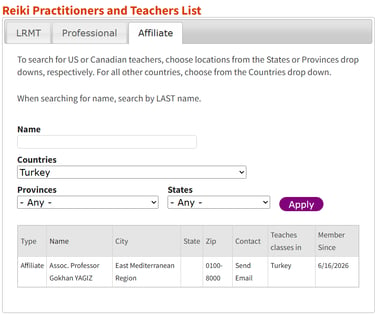
The only Reiki Practitioner in Türkiye, recognised by the International Centre for Reiki Training (www.reiki.org)
https://www.reiki.org/reiki-practitioners-and-teachers-list-0
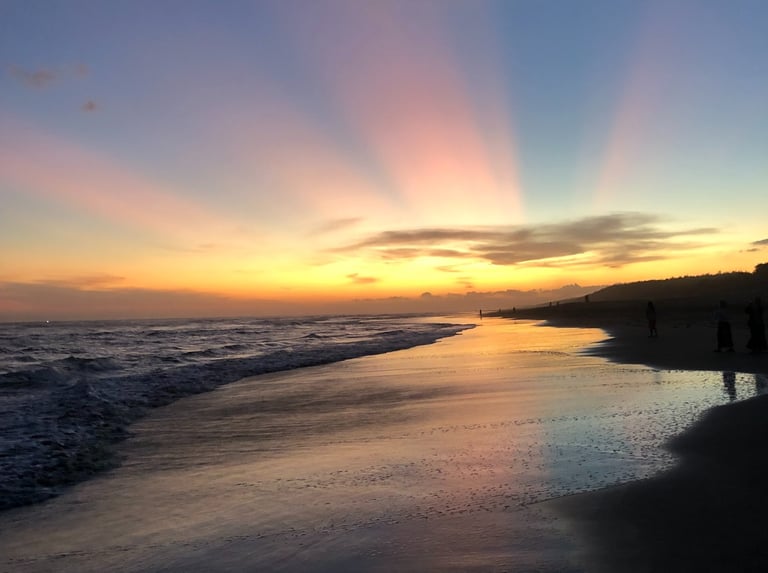
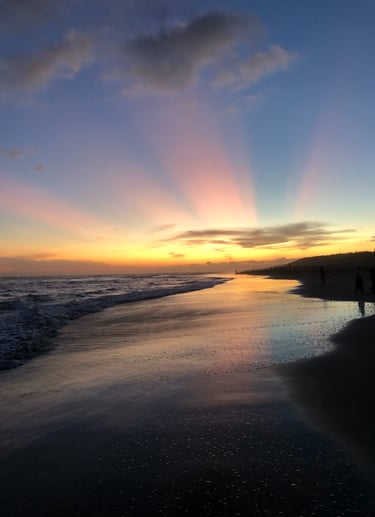
North Carolina, USA, from Gokhan YAGIZ's personal photo collection.
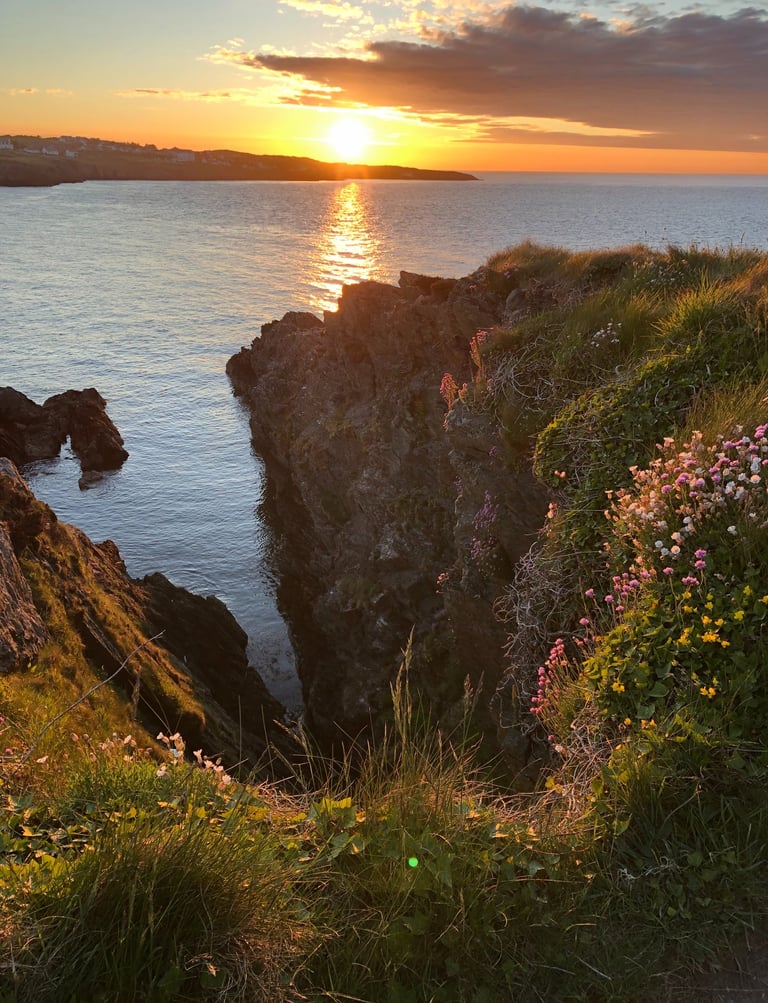
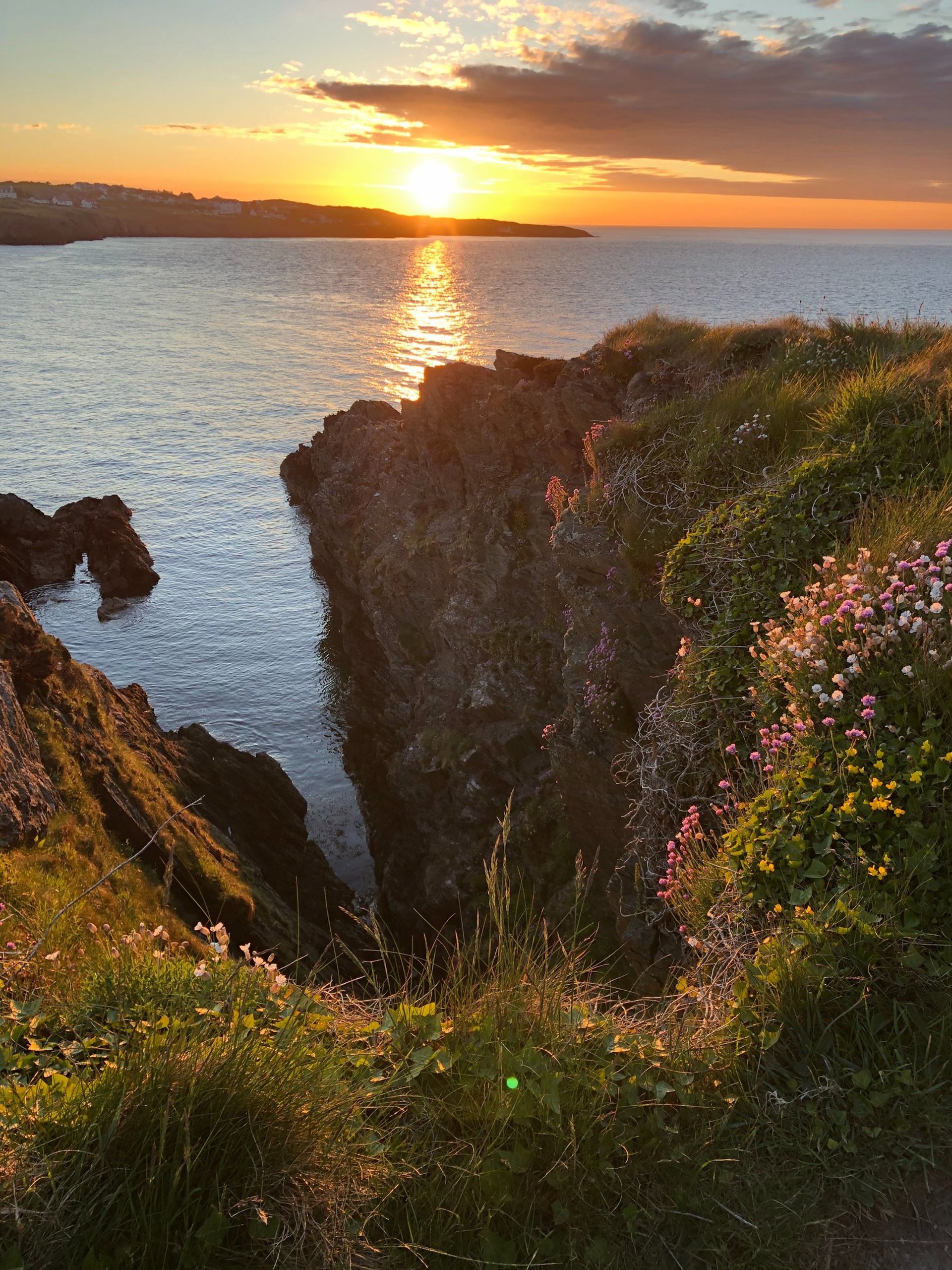
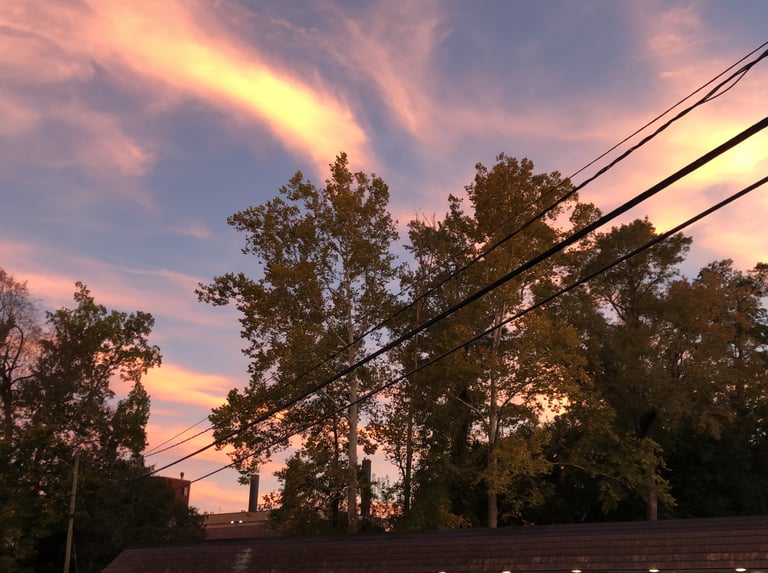
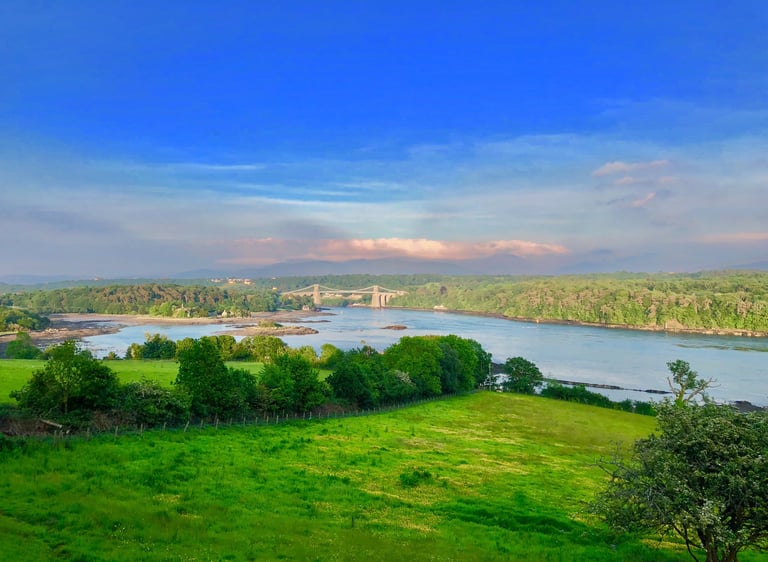
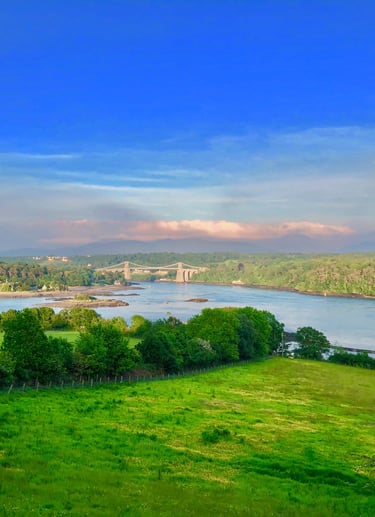
Anglesey, UK, from Gokhan YAGIZ's personal photo collection.
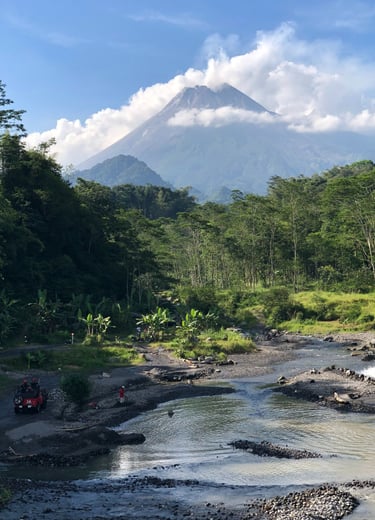
Yogyakarta, Indonesia, from Gokhan YAGIZ's personal photo collection.
Bangor, UK from Gokhan YAGIZ's personal photo collection.
What is Reiki?
Reiki (霊気) is a Japanese practice developed in the early 1900s by Mikao Usui. The word combines rei, meaning universal, and ki, meaning life energy. A Reiki practitioner uses gentle, non-invasive touch or holds their hands just above the body, with the intention of supporting relaxation and a sense of balance. Sessions are calm, quiet, and fully clothed, typically lasting 30–60 minutes.
Reiki is classified as a complementary therapy, used alongside conventional medical and psychological care rather than as a substitute. Many people describe sessions as deeply calming, a quiet space to slow down, breathe, and simply be present. As an academic in health sciences, I believe it's important to be transparent: scientific evidence for Reiki's underlying mechanisms remains limited and inconsistent, and major health authorities do not recommend it as a treatment for any medical condition. I don't present Reiki as a cure or a substitute for medical care; I offer it as a gentle, supportive practice, and I always encourage anyone with a health concern to consult a qualified healthcare professional first.
Reiki in Scientific Literature:
https://pubmed.ncbi.nlm.nih.gov/?term=reiki&filter=pubt.systematicreview
The honest picture
A consistent pattern emerges across all 32 reviews. Reiki is repeatedly described as safe, low-risk, and well-tolerated; no review reports meaningful harm. More recent and larger studies (2023–2026) increasingly report statistically significant, modest benefits for quality of life, fatigue, and procedural anxiety, particularly when used as a complement to standard medical and psychological care. However, the most methodologically rigorous reviews, including three Cochrane reviews and a formal clinical practice guideline, consistently find the evidence insufficient or uncertain, citing small trial sizes, high risk of bias, and inconsistent quality across the literature. No systematic review in this set concludes that Reiki is effective as a standalone treatment for any medical condition, and at least one formal guideline explicitly recommends against its use for fibromyalgia.
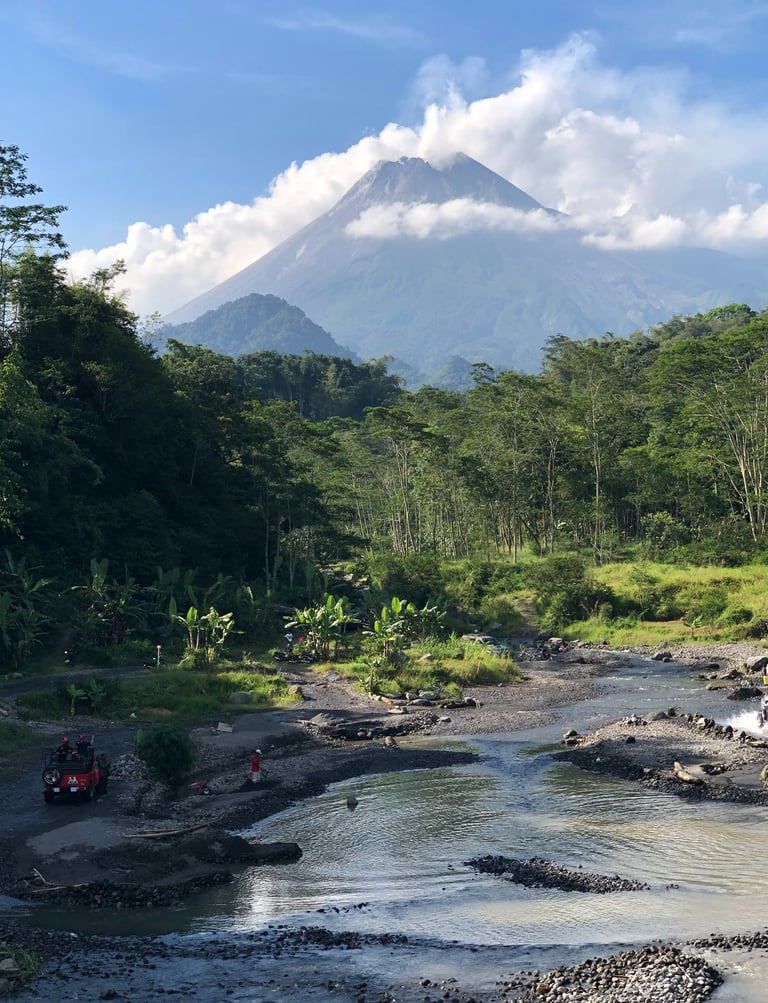
Mount Merapi (Active Volcano), Yogyakarta, Indonesia, from Gokhan YAGIZ's personal photo collection.
The Five Reiki Principles (Gokai)
These are the ethical foundation of all Reiki practice:
Just for today, I will not be angry
Just for today, I will not worry
Just for today, I will do my work honestly
Just for today, I will be grateful for my many blessings
Just for today, I will be kind to every living thing
Reiki & Nature
Reiki did not originate in a clinic or lab; instead, it arose from stillness during a man's extended retreat in Japan's mountains, where he sat with nature, silence, and pondered the meaning of healing.
That origin has never left the practice. At its core, Reiki works with “ki”, the same life energy that pulses through a forest after rain, moves through the breath of every living creature, and hums quietly beneath the surface of things we rarely stop long enough to notice. In this sense, every Reiki session is a small act of remembering: that we are not separate from the natural world but part of it.
The Five Reiki Principles: Just for today, I will not be angry; just for today, I will not worry; Just for today, I will do my work honestly; just for today, I will be grateful; just for today, I will be kind to every living thing. Carry ecological wisdom. "Every living thing" is not a footnote. It is the heart of the matter.
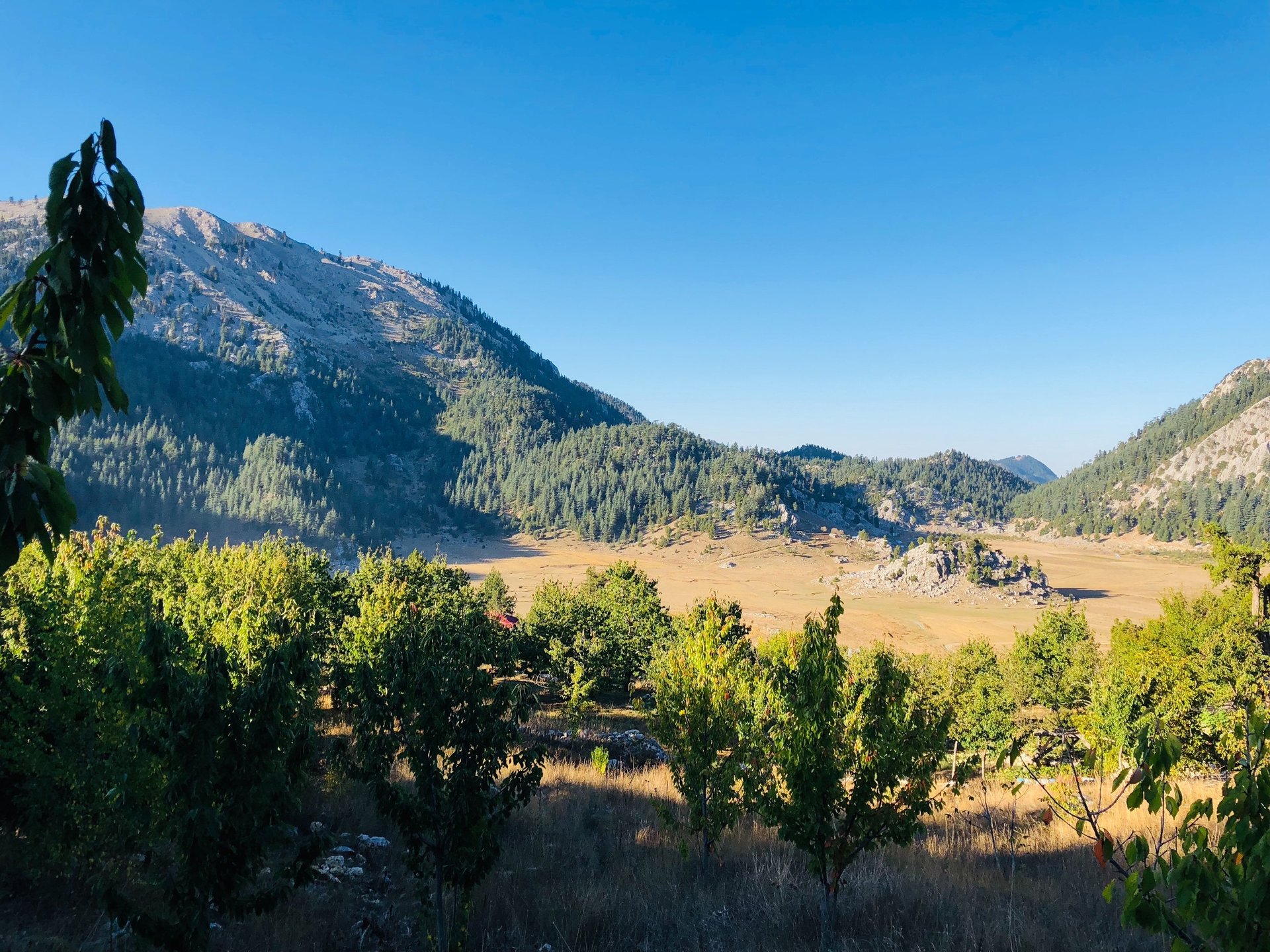
Nature requires only our presence, and Reiki asks for the same. Whether indoors or under the open sky, the invitation remains the same: To slow down, tune into what is already present, and trust that, like the earth, the body knows how to return to balance when provided with the right conditions.
Contact Us
Reach out for Reiki guidance or questions.
© 2026 reikiturkiye.com, all rights are reserved.